As one of the highest elevations in the city, the OIympic Hill (Olympiaberg) offers a magnificent view of the Olympic Village and you can even look down into the stadium. For big concerts, the seats up on the Hill are almost as coveted as concert tickets, and they’re free of charge. During the summer season, the Olympic Hill is also a great place for a picnic for two, a quick sundowner with a view or a brisk uphill walk, while in winter it’s a popular spot to go tobogganing – and rightly so! A homage.
Granted, there are higher climbs than the Olympic Hill – and not that far away, either. The high banks of the Isar river on the southern outskirts of the city are probably more formidable at several points in terms of sheer steepness and altitude. Topographically speaking, the Olympic Hill is a not so measly 565.1 metres above sea level. But Munich itself is 519 metres above sea level on average, so that shrinks the Olympic Hill to a manageable altitude of around 56 metres when you’re standing at its base:
Its name before the Games was a lot less glamorous, too: Grosser Schuttberg – which simply means “large pile of rubble”.
It’s probably one of the few “mountains” in the world that can be viewed from an adjacent TV tower which is at least five times as high – namely the Olympic Tower. The Olympic Hill was not created for the 1972 Olympic Games but originated as a mountain of rubble between the late 1940s and the late 1950s. Its name before the Games was a lot less glamorous, too: Grosser Schuttberg – which simply means “large pile of rubble”.
Strictly speaking, then, the Olympic Hill is not actually a natural rock formation at all but a grass-covered mound with a gently ascending paved path that is easy on the knees, and featuring a spacious viewing platform at the “summit” complete with telescopes and seating. That’s one way of looking it.
The sound up there is usually incredibly good – You won’t see the actual performers, of course, but you get a perfect view of the sunset instead.
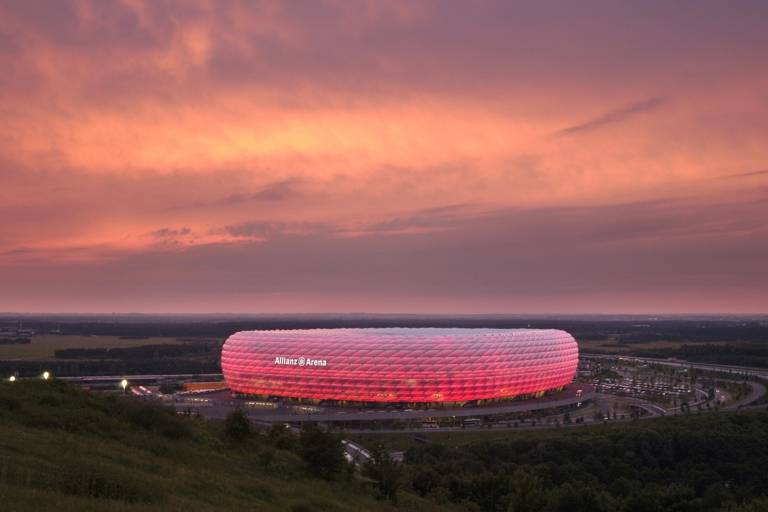
But then again, almost everything is relative. You see, from the top of this particular mound of rubble, you not only have an excellent view of the extensive Olympiapark (Olympic Park): you can also enjoy a view of concerts given by superstars in the Olympiastadion (Olympic Stadium) – from the comfort of your picnic blanket. The sound up there is usually incredibly good – after all, you can almost always rely on a westerly wind blowing in Munich. You won’t see the actual performers, of course, but you get a perfect view of the sunset instead.
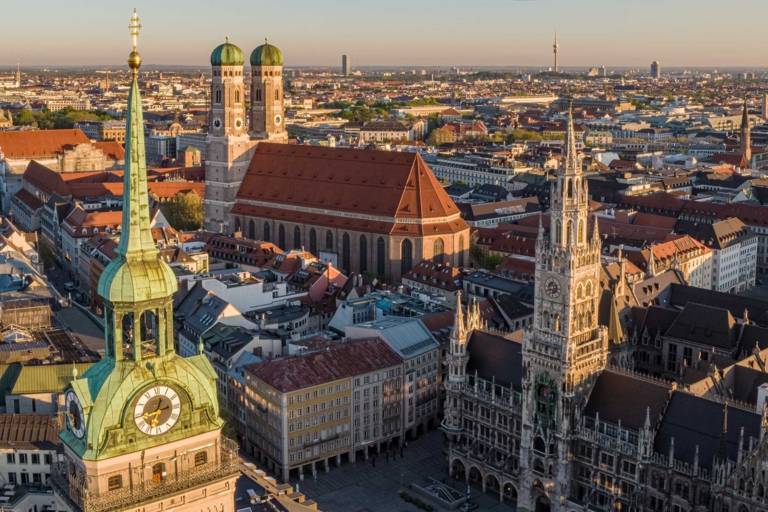
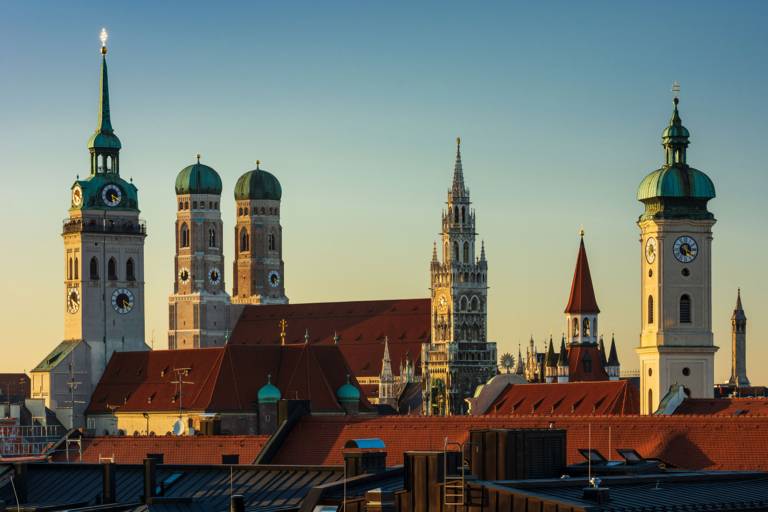
And there’s no better place to watch the sun rise again over the city in the summer. That’s the kind of moment when you suddenly realise why Thomas Mann’s ironic phrase München leuchtete (“Munich glowed”) – the very opening words of his satirical short story about Munich entitled Gladius Dei – was taken up by the city as a quite un-ironically intended catchphrase and even chosen as the name of an official medal of honour: München leuchtet (“Munich glows”). And that is what the city really does from up on the Olympic Hill at sunrise – almost painfully beautiful and utterly devoid of irony.
It’s particularly glorious when you’re lucky enough to have good visibility and the Alps appear against the light, behind the silhouette of the city. It’s also extremely practical that you only have to carry your full picnic basket up a few metres and not a few thousand metres – which you would have to do if you wanted to get a view of the city panorama from the Alps. And in that case you’d be depriving yourself of a majestic view of the Alps behind the city, of course. Not a smart option.
So in good winters when there’s plenty of snow, you might even spot the odd savvy ski tourer up on the Hill. In fact if there’s enough snow, this really is the city’s toughest ski tour. Starting from Martin-Luther-King-Weg at the foot of the Hill, the best option is to take the northern flank. Once you've done the climb about eight to ten times, at some point you’ll start to feel that genuine touring sensation. A toboggan will do too, of course.
One thing that doesn’t seem to have been such a clever decision was to hold a parallel slalom here as part of the Alpine Ski World Cup. But if you’re all aglow anyway, why not cart in a few truckloads of snow for good measure? That's what they did in 2011 and 2013. In 2013, it was actually a Bavarian who won – Felix Neureuther from Garmisch. What a hotshot.
But here we are now in summer and there’s no need for all that extra effort: the Hill is great for walking and jogging, too – you can head straight for the Olympia-Alm (“Olyalm”), for example, which was originally erected as a kiosk for the builders while construction work was going on for the 1972 Olympics. It’s now a marvellously popular beer garden. If you have children with you or not enough adrenalin in your blood, you can always do somersaults and roll down from the top afterwards.
In fact to conclude, there’s one thing we can say about hills in general – and the Olympic Hill in particular of course: no matter how high you climb, what really matters is that you make it as hard as possible for yourself to get down again.